
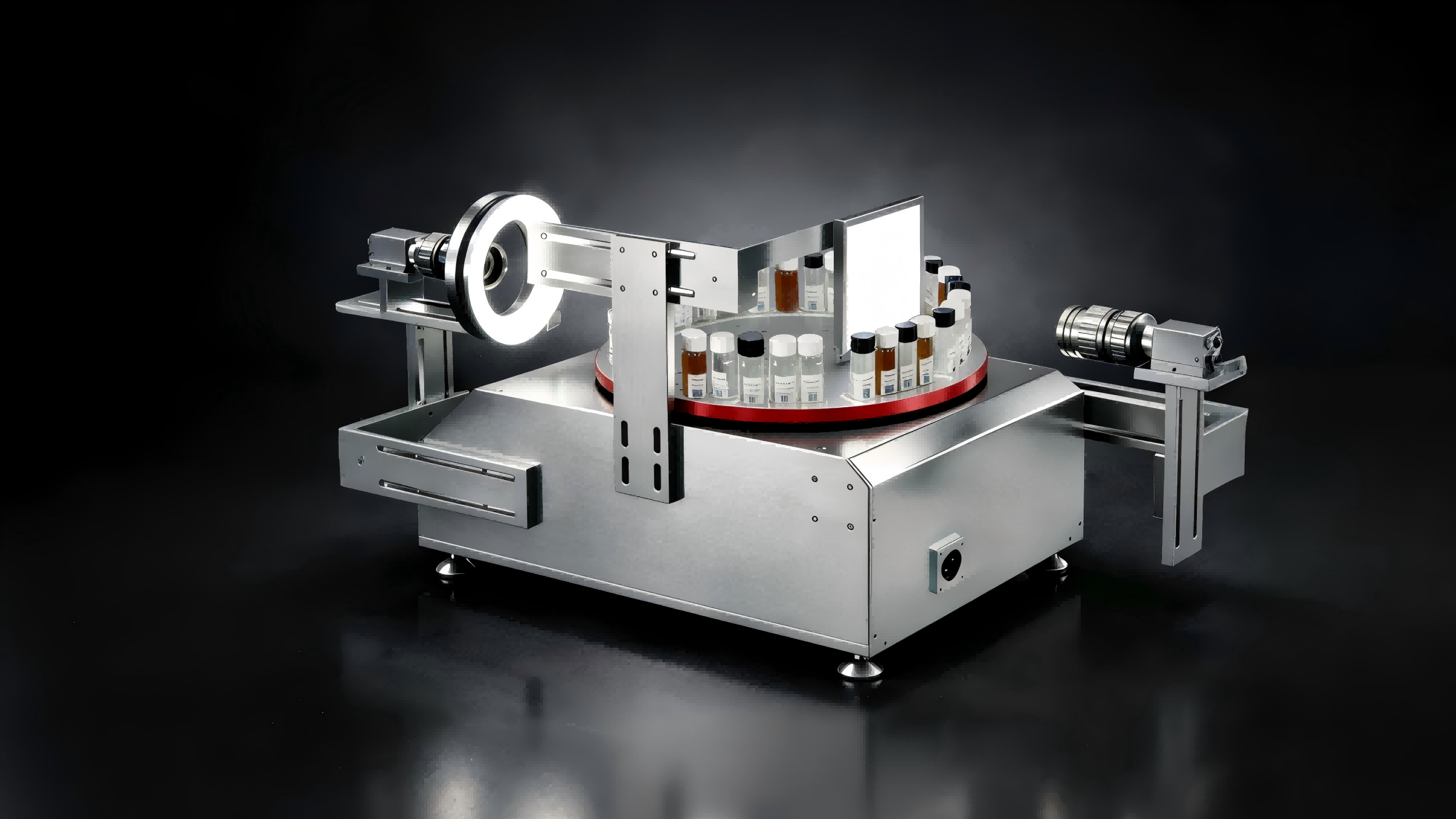
Inspection Demo for Medical Reagent Bottles
In pharmaceutical packaging manufacturing, tiny glass defects, liquid level deviations, cap color inconsistencies, misprinted label text, and missing or erroneous Datamatrix codes on medical vials directly jeopardize drug safety, and all inspection procedures must fully comply with GMP regulatory standards. The HWAINTEK HM series all-in-one vision and motion controller adopts a virtual machine dual-system deployment architecture, equipped with two fixed camera inspection stations integrated with deep learning image analysis, OCR character recognition, and Datamatrix decoding capabilities. Camera 1 with ring light and Camera 2 with backlight perform differentiated inspection tasks respectively. A central servo turntable rotates vials 360° to enable full-surface image capture. There is no separate upstream feeding process on the equipment, achieving 100% full in-line inspection for pharmaceutical glass vials, injection vials, and ampoules.
Turntable Conveying Stage: Central Servo Turntable Cycles Workpieces for Synchronized Imaging at Dual Fixed Cameras
This unit is solely responsible for cyclic workpiece transfer and multi-angle imaging positioning without independent upstream feeding. Medical vials are continuously fed into fixtures on the central servo turntable and rotate at a constant speed to pass two stationary fixed camera stations for synchronous image acquisition, ensuring stable and efficient inspection throughput.
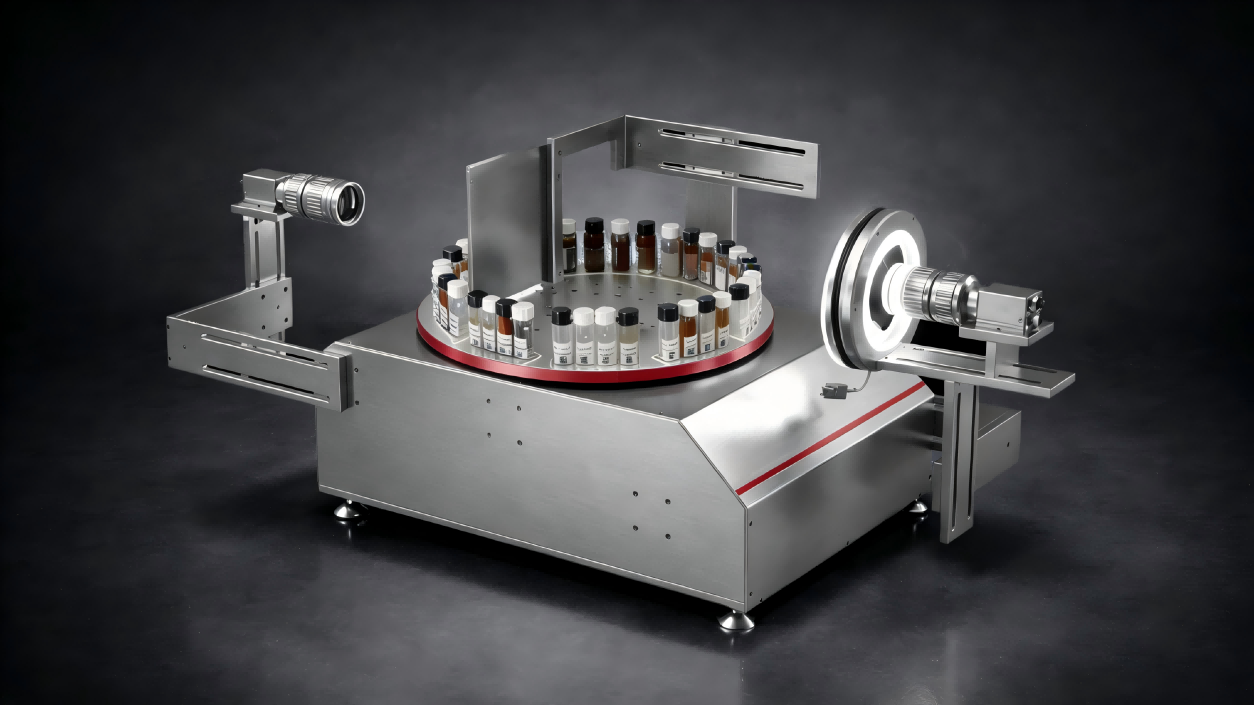
Typical process modules:
Positioning & rotation of central servo turntable: Only the central turntable is driven by a servo motor, rotating medical vials 360° at uniform speed to fully expose the side walls, caps, and liquid areas of vials, providing dead-angle-free imaging conditions for the two fixed cameras. Both camera inspection stations remain stationary with no independent rotating motion fixtures.
Differentiated camera & lighting layout for dual stations (referencing inspection dimensions on the Inspector HMI interface):
Camera 1 (Fixed station with ring light): Equipped with a ring light to capture flat images of vial labels, completing OCR text reading, Datamatrix decoding, and cap color identification.
Camera 2 (Fixed station with backlight): Equipped with a bottom backlight for light transmission imaging, verifying liquid filling levels, glass cracks, foreign contaminants, and cosmetic defects on vial bodies.
As the core vision processing and motion scheduling unit of the entire equipment, the HWAINTEK HM series all-in-one controller is built on high-performance multi-core CPUs and a virtualization architecture that supports isolated Windows + Linux dual virtual machine deployment with customizable independent CPU core resource allocation. The controller outputs millisecond-level synchronous trigger signals to Camera 1 and Camera 2, and sends separate indexing and rotation positioning commands to the central servo turntable. It supports uninterrupted 24/7 stable operation in GMP cleanroom environments.
Differentiated Deep Learning Inspection Stage at Dual Fixed Stations: Integrated Vision Calculation & Real-Time Soft PLC Motion Control
This core quality control unit features two stationary camera stations. Workpieces are conveyed by the central servo turntable for time-sharing dual-channel imaging inspection. Images captured by both cameras are simultaneously sent to vision software for multi-dimensional full-item inspection via deep learning algorithms. The system synthesizes data from both cameras to output unified pass/fail judgments and links downstream actuators to automatically sort out defective products.
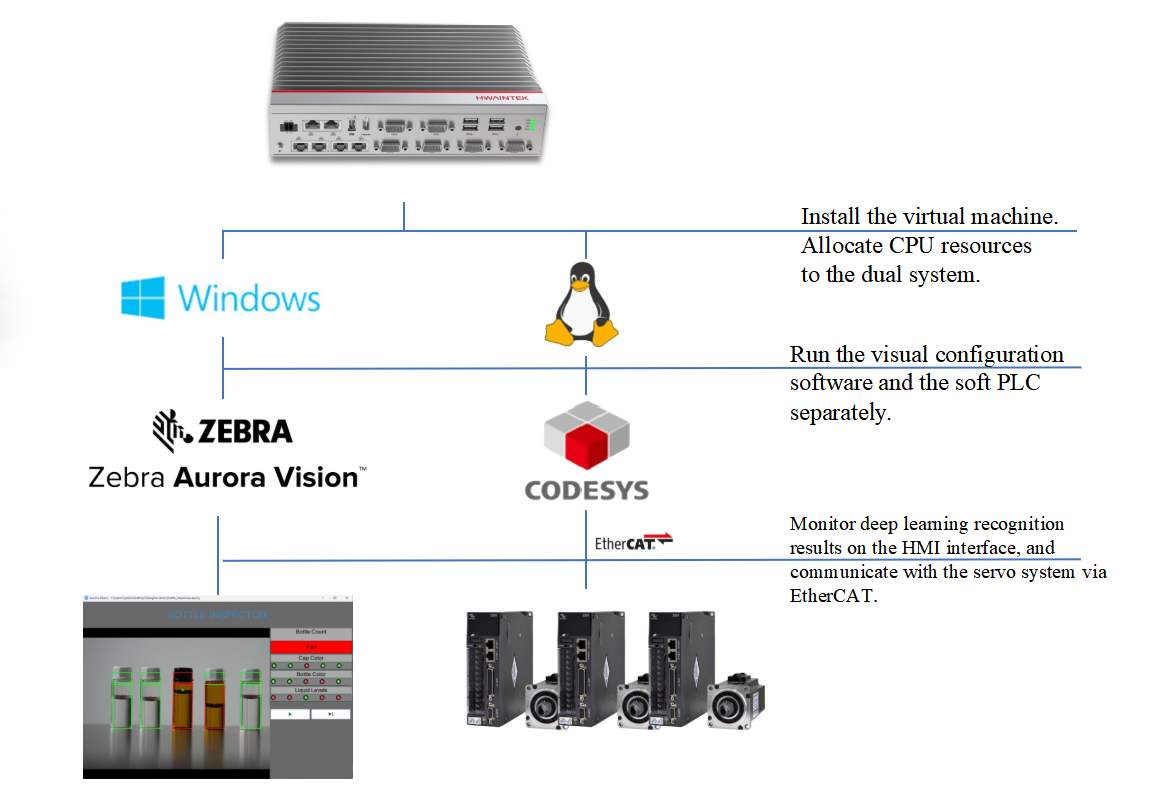
Key process modules:
Inspection items of Camera 1 (Ring light label inspection station):The fixed ring-light monochrome camera captures images of vial labels and caps, leveraging deep learning and Zebra vision algorithms to implement three inspection functions:① OCR character recognition: Reads printed text including drug names, specifications, concentrations, and production batch numbers to identify blurry, missing, or misprinted labels;② Datamatrix decoding: Fully parses 2D matrix codes on vials to extract batch traceability codes and match production archives;③ Cap color inspection: Distinguishes qualified green caps from defective red caps, detecting missing or deformed caps.
Inspection items of Camera 2 (Backlight liquid level inspection station):The fixed backlight monochrome camera captures transparent images of vial bodies, performing vial body inspection via deep learning:① Liquid filling level verification: Checks liquid heights against standard thresholds to detect underfilled, overfilled, or empty vials;② Micro glass defect detection: Identifies micron-level flaws such as micro-cracks on bottle walls, glass debris inside vials, black spots, and bottle deformation;③ Bottle counting & integrity verification: Counts passing vials and detects missing or damaged bottles.
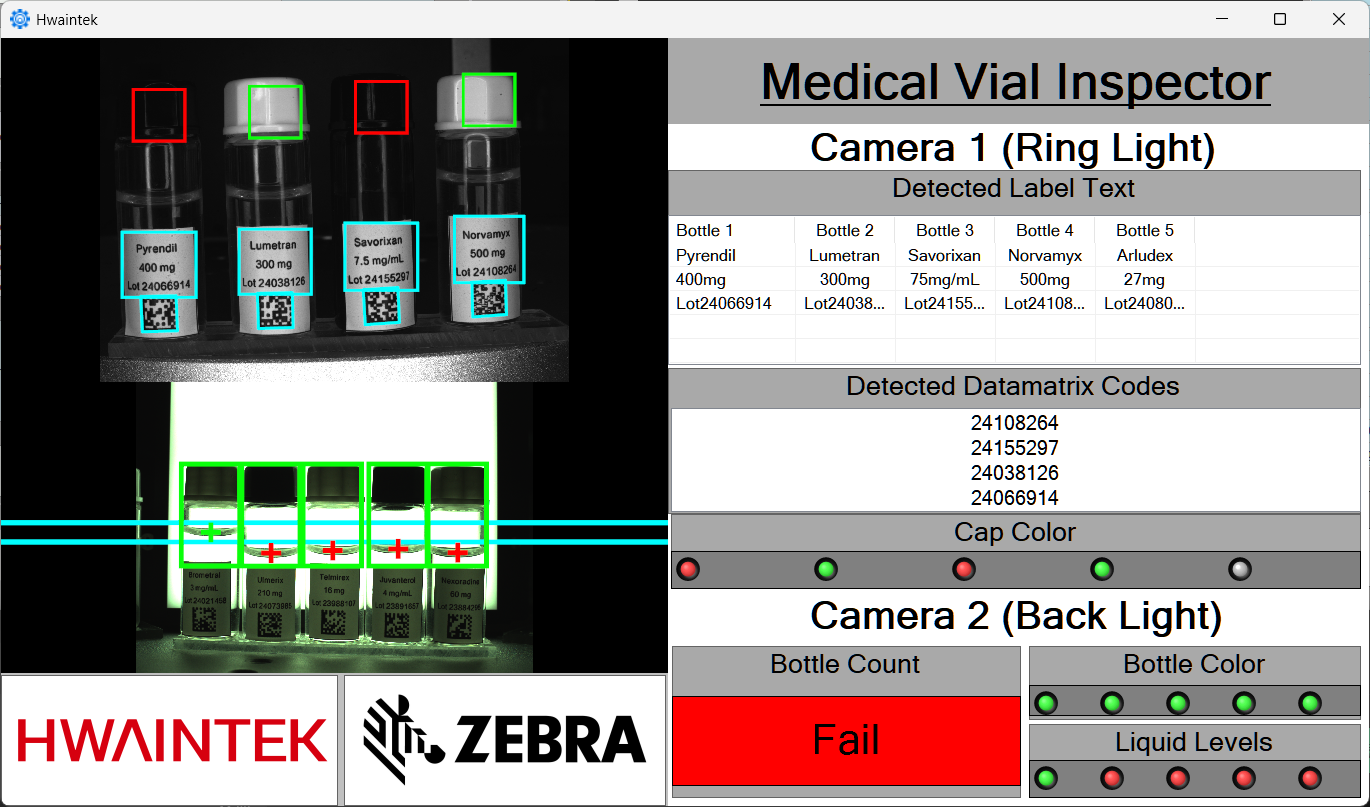
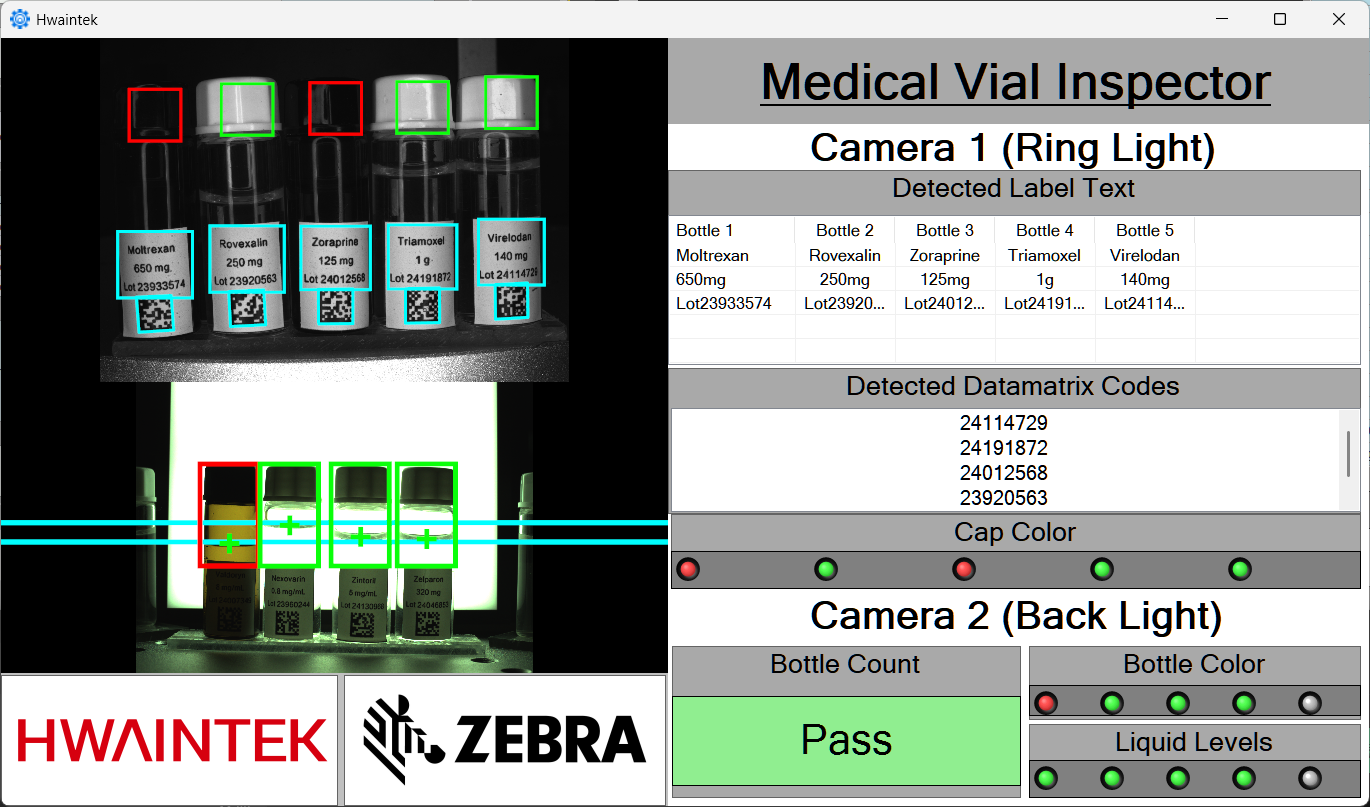
Unified computing via Zebra Aurora Vision platform: The Linux virtual machine runs vision configuration software to receive parallel image streams from Camera 1 and Camera 2, executing deep learning defect judgment, OCR character recognition, and Datamatrix decoding simultaneously. Visual tasks for the two stations operate with isolated computing resources without resource contention.
Coordinated motion control via independent CODESYS soft PLC: The soft PLC runs on an isolated dedicated CPU core, solely managing indexing and rotation positioning of the central servo turntable as well as downstream defective product sorting actuators, and transmits real-time motion commands to servo systems via the EtherCAT bus.
Real-time HMI monitoring (consistent with the attached Inspector interface): The Windows virtual machine hosts a dedicated Medical Vial Inspector touchscreen interface, displaying real-time live feeds from both cameras, recognized text lists, decoded 2D code data, red/green status indicators for caps, liquid level inspection status, and a final overall Pass/NG judgment result. The system integrates label inspection data from Camera 1 and liquid level & defect data from Camera 2 to output unified sorting signals for EtherCAT servo sorting actuators to automatically reject defective vials.
The HM series native isolated dual virtual machine architecture allocates independent hardware resources for high-load vision computing and real-time soft PLC operations, completely eliminating performance conflicts between deep learning image analysis, OCR character recognition, Datamatrix decoding, and hard real-time motion control. Equipped with multi-channel GigE camera ports, digital I/Os, and EtherCAT master ports, the controller forms a complete closed-loop system covering dual-station image acquisition, multi-dimensional deep learning analysis, character & 2D code verification, and servo motion execution, delivering stable micron-level detection accuracy for liquid levels, caps, printed text, and glass defects.
Typical Layered Topology Architecture of Controller for Dual-Station Medical Vial Inspection Equipment
Centered on the HWAINTEK HM all-in-one vision & motion controller, an efficient closed-loop layered control framework is constructed as follows:
1. Perception Layer
Two fixed camera stations connect to the controller via GigE Vision interfaces: Camera 1 with ring light and Camera 2 with backlight, paired with ring lights, backlights, and position sensors. The central servo turntable and downstream sorting servo actuators all communicate through the EtherCAT fieldbus.
2. Dual-System Computing & Control Layer
The HM virtualization platform deploys two isolated virtual machines with dedicated allocated CPU cores:
Linux Virtual Machine: Runs Zebra Aurora vision software to process parallel image streams from Camera 1 (labels) and Camera 2 (vial bodies), simultaneously executing deep learning defect detection, OCR printed character recognition, and Datamatrix decoding.
Windows Virtual Machine: Runs CODESYS soft PLC to implement full-process real-time motion logic control for the central servo turntable and sorting actuators. It hosts the dedicated Medical Vial Inspector HMI to display live feeds from both cameras, OCR text, 2D code data, cap & liquid level inspection status, and final judgment results in real time.
3. Actuation & Management Layer
Drives the central servo turntable and defective product sorting actuators via the EtherCAT servo bus. It connects upward to pharmaceutical MES systems through industrial Ethernet to fully archive deep learning defect logs, OCR character verification records, 2D traceability codes, liquid level and cap inspection data, and automatically generate batch quality reports to achieve full traceability of all pharmaceutical inspection data.
This dual virtual machine architecture enables conflict-free parallel operation of high-load deep learning vision algorithms, OCR character recognition, Datamatrix decoding, and hard real-time servo motion control, supporting stable high-speed operation of the full workflow including cyclic turntable conveyance, multi-dimensional synchronous dual-station inspection, and automatic defective product rejection.
There's also a video for this demo: https://www.linkedin.com/feed/update/urn:li:activity:7441679533503774720